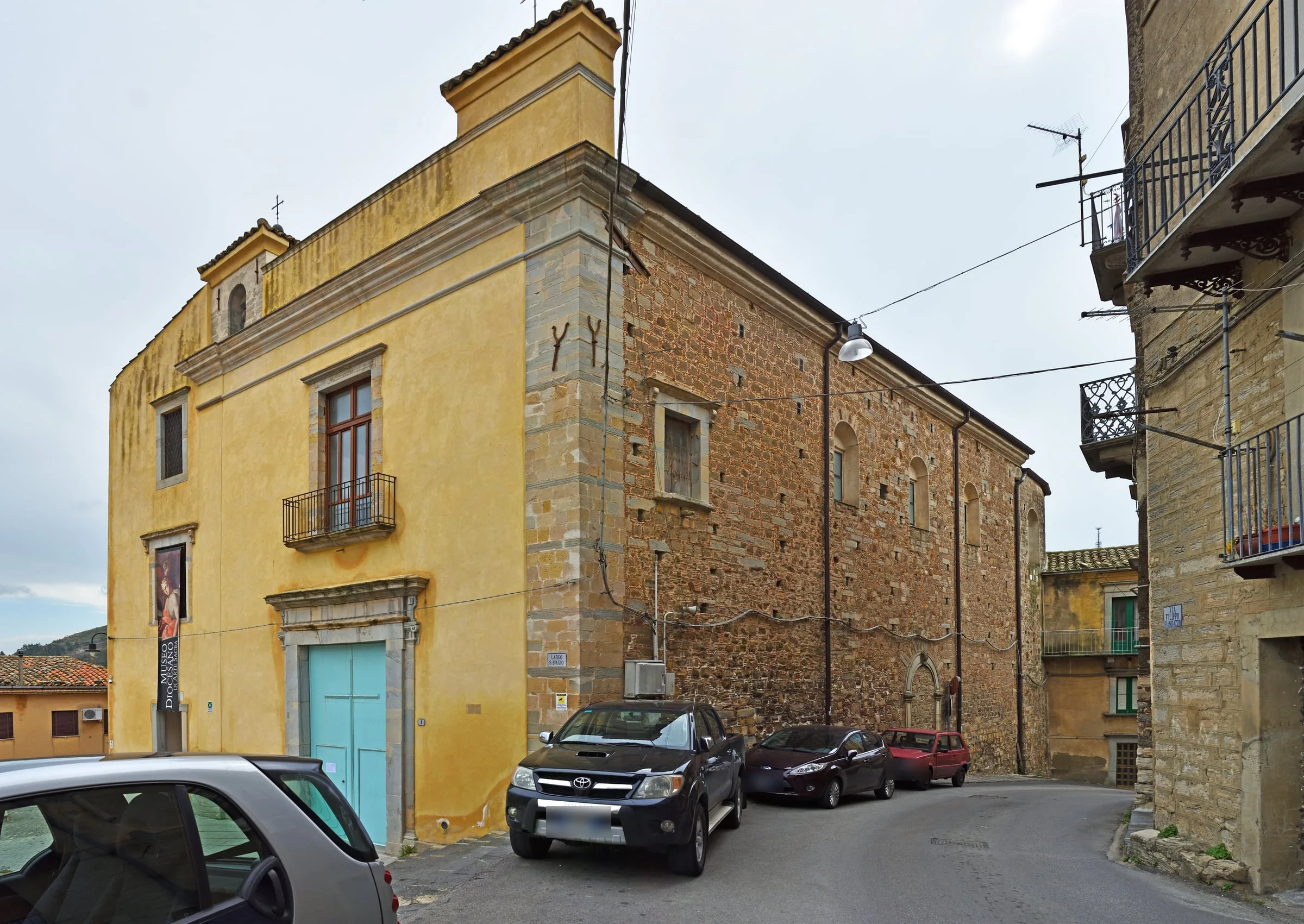
A Benedictine church transformed several times
The Church of San Biagio stands on Via F. Randazzo, annexed to an ancient Benedictine monastery. It was already complete on 11 June 1433, was then enlarged between 1698 and 1729 and finally restored in 2010-2011 — the external front by the architect P. Gurgone, the interior by the architect Carla Mancuso, both of the Enna Superintendence. After the suppression of the monastery, part of the building was sold to private owners; the remaining wing housed the Episcopal Seminary, which stayed there from 1889 to 1960.
The interior and the crypt
The hall has a single nave, covered by a barrel vault with lunettes set on a trabeated cornice that runs around the whole space. Below it extends a crypt, partly cut into the rock and divided into several rooms. The walls are clad in refined Rococo-style stuccoes and gilding, carved in the first half of the 18th century by Serafino Perollo.
The works of art
For the altars, G. Velasco painted five canvases between 1772 and 1775:
- San Biagio healing a man sick in the throat;
- Ecstasy of Santa Scolastica;
- Martyrdom of San Placido and his companions;
- Presentation of Jesus at the Temple;
- San Benedetto felling the statue of Apollo.
On the high altar, behind the painting of San Biagio, is the statue of the saint carved in the 17th century by Li Volsi. Also preserved are the Group of the Flagellated Christ by G.B. Li Volsi, the bier of San Lorenzo from Santa Maria, the bier of San Bartolomeo from the Cathedral and the episcopal throne donated to the Cathedral by Monsignor Avarna. The ancient organ has recently been restored. Finally, notable is the monumental wooden tabernacle, from the church of Santa Maria di Gesù, a work of carving attributable to Pietro Bencivinni or his school.
Source
The historical and artistic information in this entry is drawn and summarised from the Church of San Biagio entry of the Ecomuseo Petra d’Asgotto in Nicosia (ecomuseonicosia.it), which is credited for documenting Nicosia’s sacred heritage.
Gallery
Where it is
Via F. Randazzo, historic centre, Nicosia (Enna)