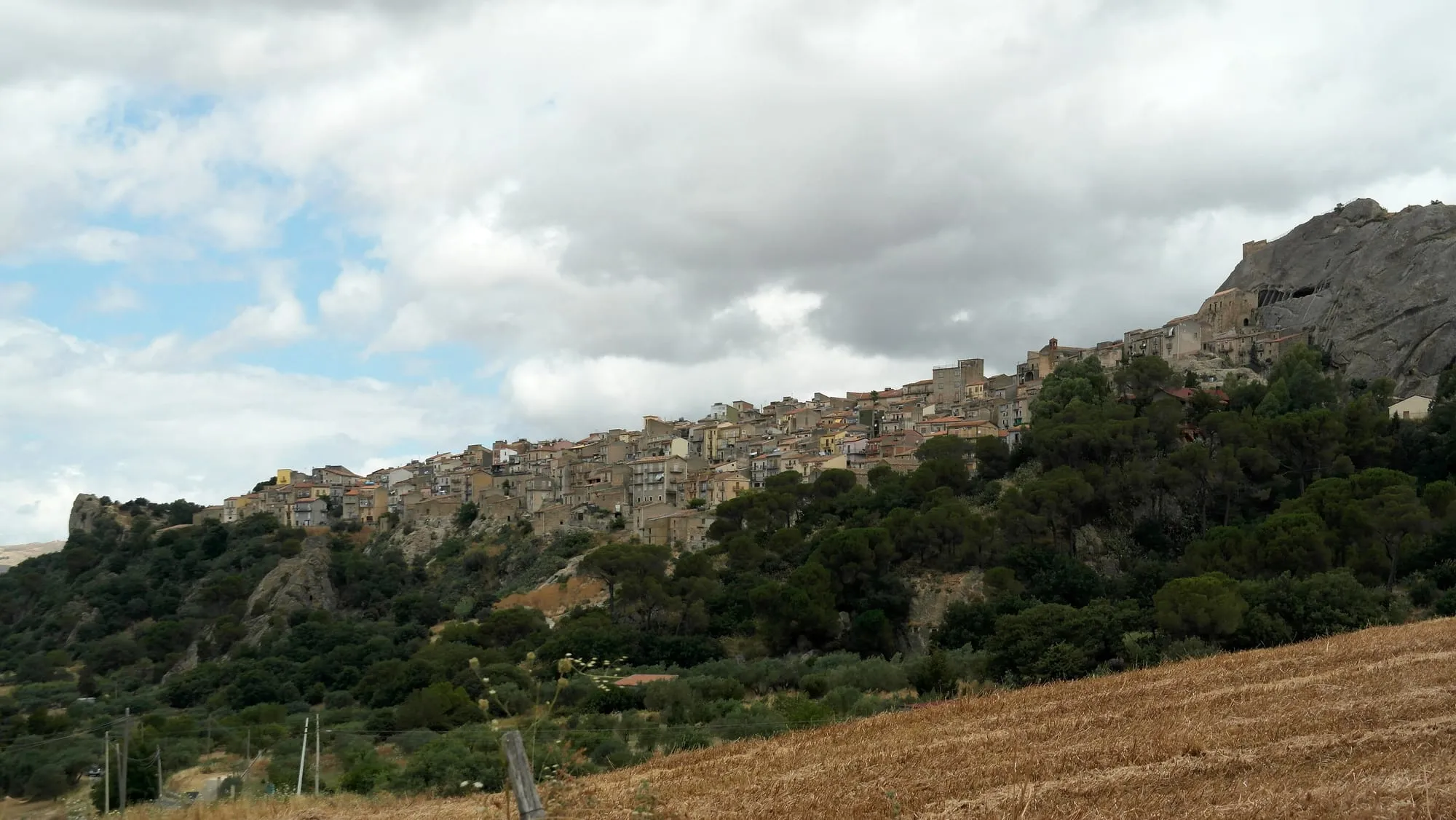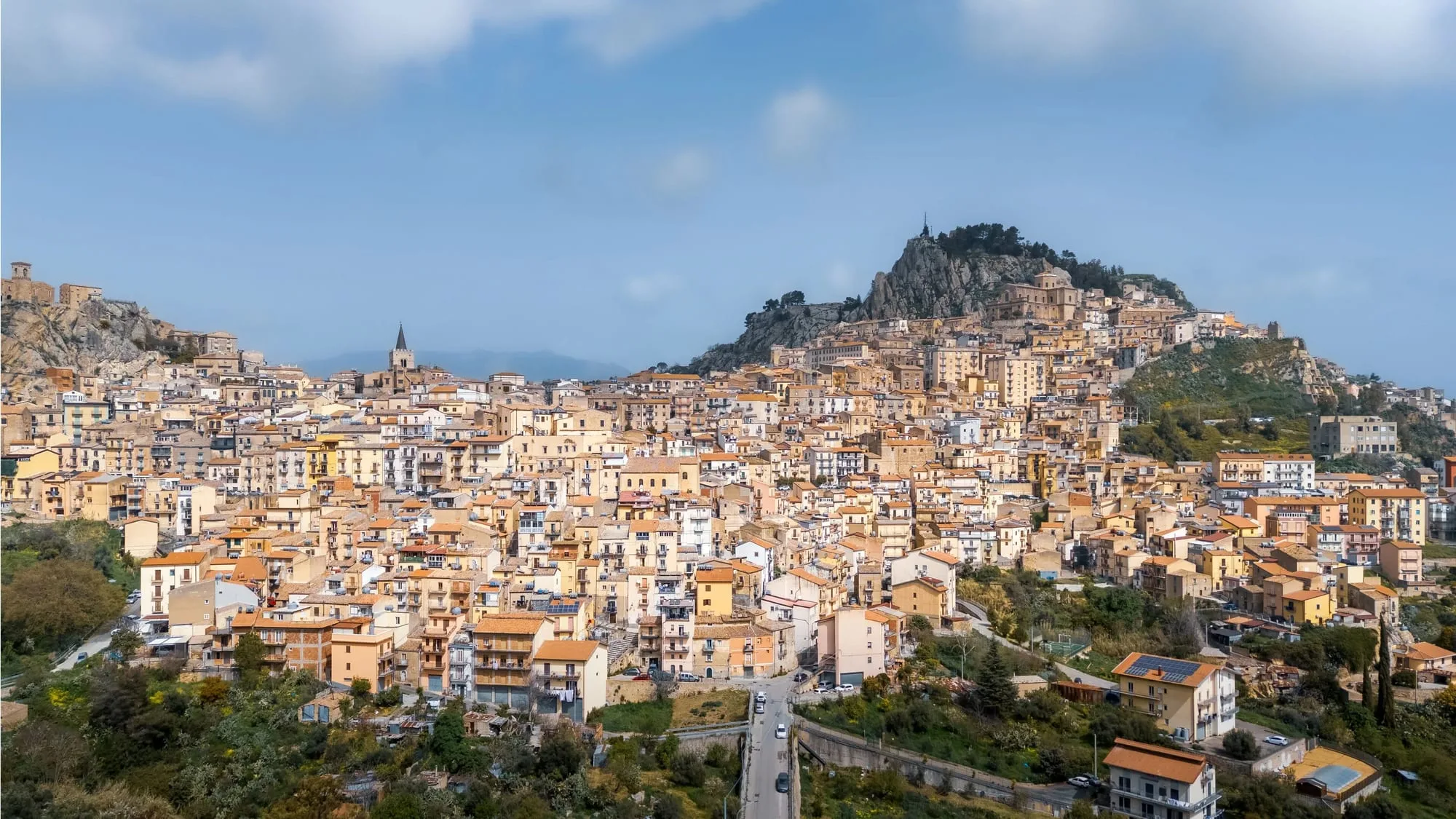
Nicosia is a town of about 12,400 people in the province of Enna, built on four hills at over 700 metres, where the Nebrodi mountains slope down toward the Sicilian interior. Search for it online and the capital of Cyprus almost always comes first. But those who make it this far find things Cyprus doesn’t have: a 14th-century cathedral that hides a painted ceiling from the 1400s above its vault, the ruins of a Norman castle, caves lived in until a few decades ago, and a medieval dialect that arrived from northern Italy.
This guide gathers what makes the trip worthwhile, with links to the detail pages for opening times, access and bookings. It’s written by the Vivi Nicosia editorial team.
Where Nicosia is (no, not the one in Cyprus)
Let’s clear up the confusion first: Nicosia in Sicily has nothing to do with Lefkosia, the capital of Cyprus. It sits in the north of the province of Enna, along the SS117 road that cuts the island from north to south, in the inland Sicily that coastal tourism barely touches.
Geography already explains much of its history. The town spreads across four hills and was, for a long time, a wealthy crossroads: a royal town from the 12th century, answering directly to the king rather than to a feudal lord, with the title of “Civitas Costantissima”. It is known as the “city of the 24 barons” after the noble families who lived here in the 1700s — by tradition, 24 barons, two marquises, a count and more than 250 gentry families. What survives of that age are the palaces that still line the streets of the historic centre.
There’s a quirk you hear before you see it. Nicosia still speaks Gallo-Italic, a language brought between the 11th and 13th centuries by settlers the Normans called in to repopulate inland Sicily: they came mostly from the southern Piedmont and the Ligurian hills, “Lombards” in the medieval sense. Nicosia is one of six Sicilian towns where this language survives, together with nearby Sperlinga. Older residents still speak it among themselves, at the market and in the clubs.
Piazza Garibaldi and the Cathedral of San Nicolò
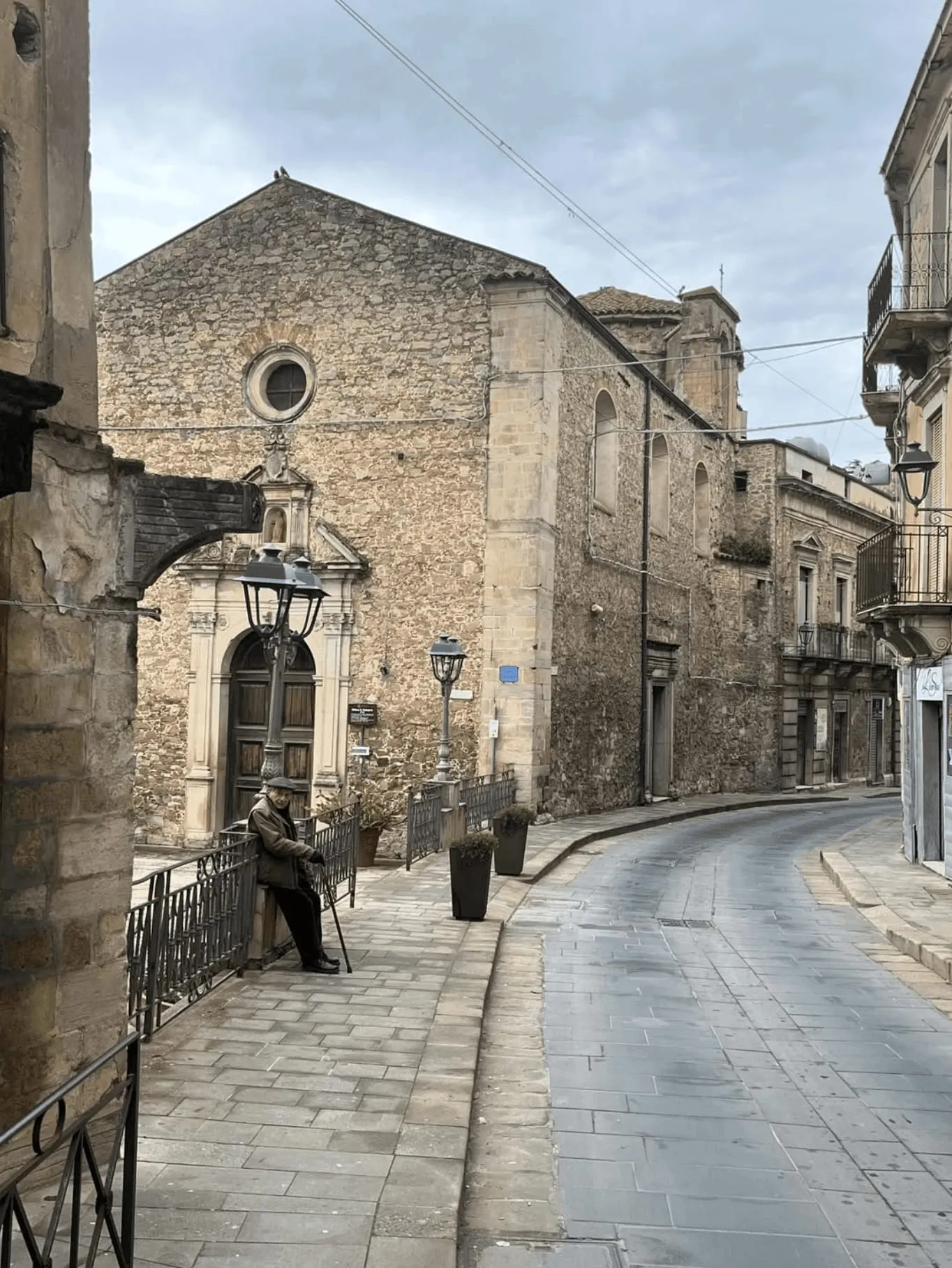
The starting point is Piazza Garibaldi. Facing the square is the Cathedral of San Nicolò, recorded as early as 1340 and made a cathedral in 1817, when Pius VII created the diocese of Nicosia. Since 1940 it has been a national monument.
The exterior deserves time: the Gothic portal known as the Porta del Paradiso, with its acanthus-leaf carving, and the three-tier Gothic bell tower, about forty metres tall, with mullioned windows sculpted between the late 1300s and the mid-1400s.
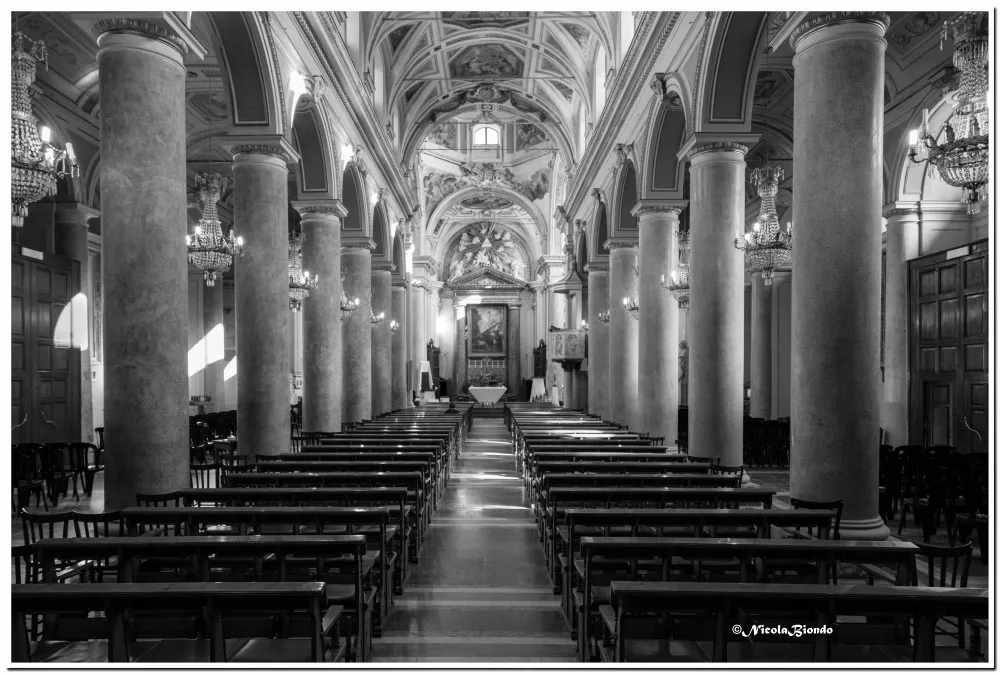 The central nave of the Cathedral. Photo © Nicola Biondo.
The part that matters most, though, isn’t visible as you walk in. Above the barrel vault frescoed in 1810 by the Manno brothers survives the painted wooden ceiling made between the 14th and 15th centuries: bays of decorated trusses with sacred and, above all, secular scenes — ladies, hunts, animals, a Gothic alphabet. For Nicosia’s Ecomuseum it is the only example in Italy of a painted truss roof; Federico Zeri called it “an extraordinary, unique monument”. For a century only scholars and restorers saw it. Since June 2024 a multimedia platform made by the Diocese lets you explore it panel by panel: the practical details are on the Cathedral page, and the full story is in our in-depth guide to the Cathedral of San Nicolò and its painted ceiling.
Santa Maria Maggiore and the throne of Charles V
A few minutes on foot and you climb to the Basilica of Santa Maria Maggiore, the other half of the town’s religious story. For centuries the two rival quarters — the Mariani of Santa Maria, of Lombard origin, and the Nicoleti of San Nicolò — disputed precedence and processions; some echo of that rivalry still surfaces in the festivals.
The Norman church was overwhelmed in 1757 by a landslide, the “lavanca”, and rebuilt in late-Baroque forms. Inside is the piece that alone justifies the climb: the Cona by Antonello Gagini, a monumental marble polyptych already in place by 1512, which survived the landslide. Beside it, a wooden stall from around 1518 that locals call the throne of Charles V: the emperor sat here in 1535, passing through Nicosia on his way back from the Tunis campaign.
The Castle and the town from above
From the square you climb to the Castle along stairways and alleys that cut through the historic centre. The rock was already settled by the Sicels in the 7th century BC, then became a Byzantine and finally a Norman outpost, from 1062. Of the ramparts there remain ruins, a bridge with a pointed arch, stairs carved into the rock and the “grotta di nigrò”, a burial cavity never fully explored. The real reason to climb is the view: from up here the four hills, the bell towers and the rooftops read in a single glance, and the eye reaches the valley of the Nebrodi.
The cave dwellings, the carved town
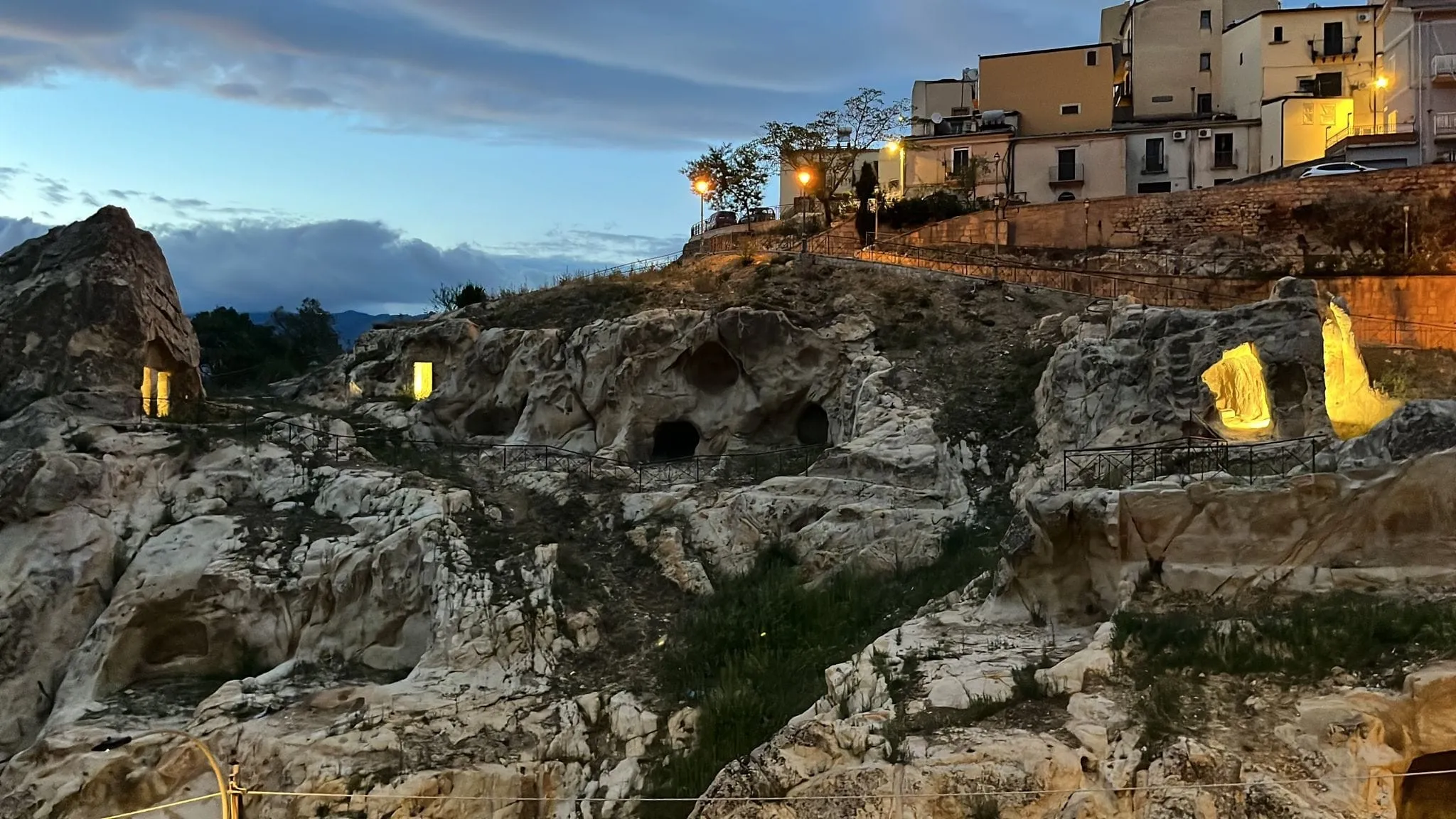 The cave dwellings below the Castle spur. Photo © Comune di Nicosia.
Below the Castle spur opens the oldest Nicosia: the cave dwellings, cave-homes carved into the rock and lived in from prehistory until a few decades ago. This is not a fenced site with a ticket office: you find them by walking, among climbs and stairs, with access marked on via Nisi. The complex has been repeatedly nominated to Italy’s FAI “Luoghi del Cuore” census (editions from 2016 to 2022). Anyone who wants to understand them properly can book the cave dwellings trek, three hours with a guide among the caves and the panoramic paths.
The Giudecca and the barons’ palaces
Between Cathedral and Castle you cross the Jewish quarter, the Giudecca. Nicosia’s Jewish community appears in nearly every 15th-century tax roll of the Kingdom of Sicily, until the expulsion of 1492; what remains is the memory in the name of via Giudecca, the narrow alleys and the tower-houses of the eastern historic centre.
The rest of the centre speaks the language of the barons: the palaces of the noble families follow one another along via Fratelli Testa and the surrounding streets, among Baroque portals, mascarons and neoclassical courtyards. The best way to line them up is the historic-centre walking tour.
On that note: you often read that Nicosia is the “town of a hundred churches”. The documented numbers are more sober but still remarkable — in the early 1700s there were 84, with six convents and four monasteries. For a provincial town that’s an off-the-scale density, and many can still be visited.
The mountains: Sambughetti and the Campanito lakes
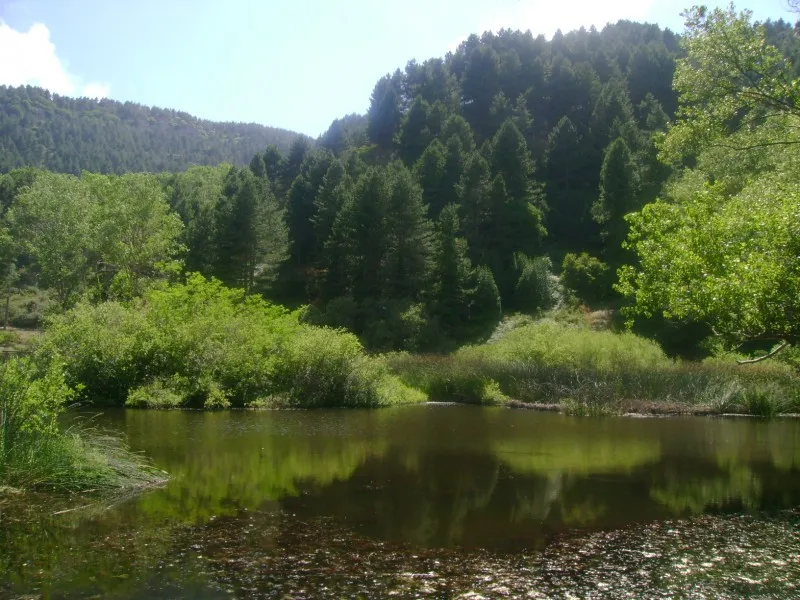 The Campanito lakes, in the nature reserve above Nicosia. Photo © Foto territorio Nicosia.
Nicosia is also mountains. North of the centre, along the SS117, you enter the Sambuchetti-Campanito nature reserve: 2,358 hectares between Nicosia and Cerami, established in 2000. Here stands Monte Sambughetti, which at 1,559 metres (per the Sicilian Region) is among the highest peaks of the province of Enna, covered by a relict beech forest from the Ice Age, one of the southernmost in Europe. At the foot of Monte Campanito, three natural basins form the Campanito lakes, which the Sicilian Region lists among the most important wetlands of the Nebrodi: in summer they fill with duckweed, in winter you may find them frozen under snow.
One useful clarification: Nicosia’s mountains belong to the western Nebrodi, but the municipal territory does not fall within the Nebrodi Park — of the Enna-province towns, Cerami and Troina do. The regional reserve is freely accessible and well-marked; for a guided outing there’s the mountain trek.
What to eat (and drink)
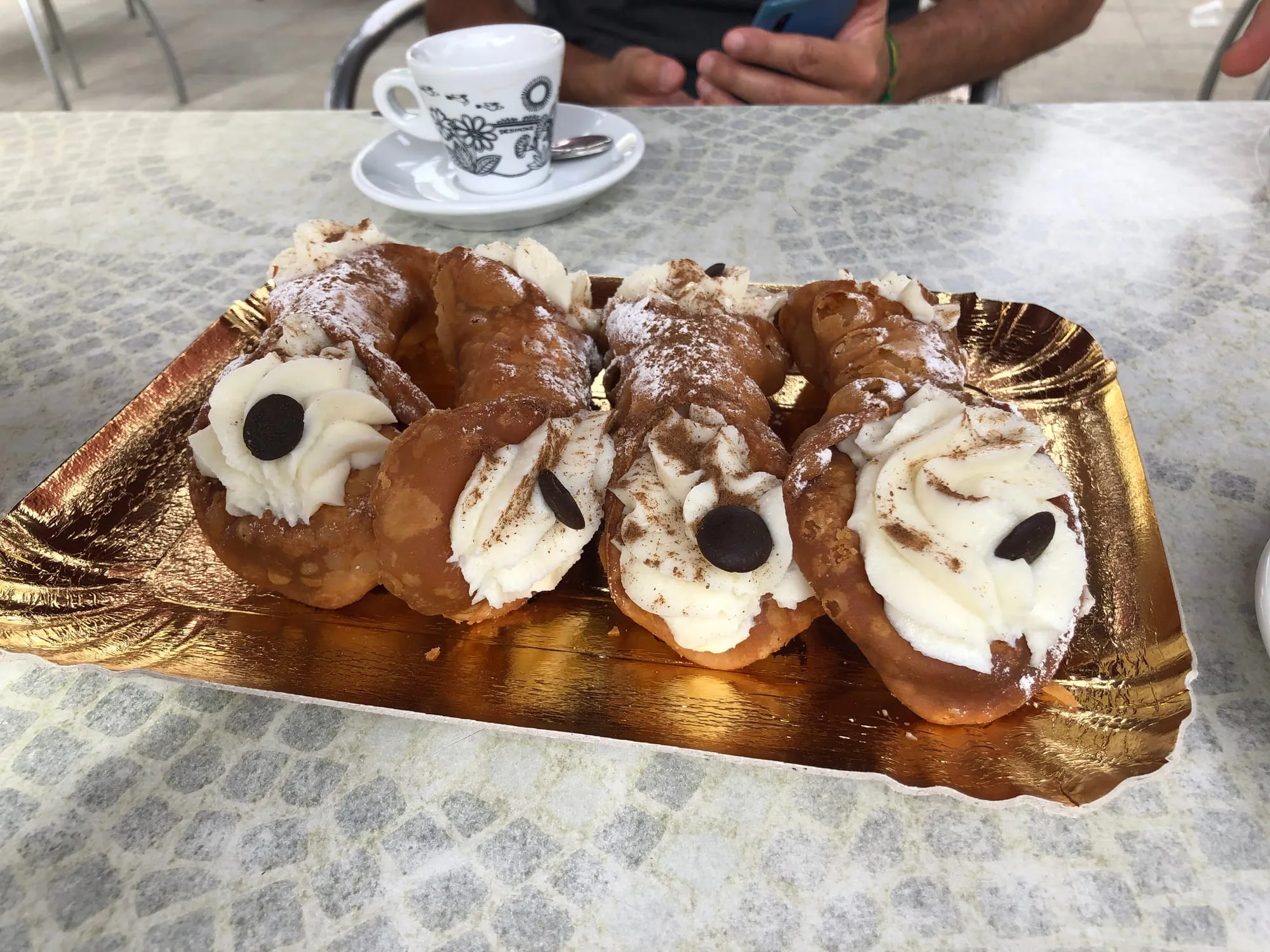
Nicosian cooking is mountain cooking: shepherding, wheat, gardens. Two addresses tell the supply chain well. The Albereto dairy works buffalo milk in the Albereto district, in the countryside of Nicosia, with visits and tastings. The 24 Baroni brewery took its name from the 18th- century baronial families; the visit with tasting is quick to book. For a wider taste of the local basket — cheeses, extra-virgin olive oil, sweets — there’s the Cheese and EVO oil experience.
When to go: Carnival, the Casazza and the festivals
The festival calendar is dense, and it’s worth timing your visit to it. The historic Carnival is village satire and traditional masks, between January and February. During Holy Week comes the Casazza, the sacred pageant that Giuseppe Pitrè called “the most solemn, the most resounding” in the whole island (1881), back on the streets since 2016. Between late August and early September the town celebrates San Felice, the Capuchin friar from Nicosia canonised in 2005, co-patron alongside patron San Nicolò. The events calendar keeps the dates up to date edition by edition.
Local tip: if you can pick only one date, aim for Holy Week. The Casazza can’t be booked and isn’t ticketed: you just follow the procession.
Nearby: Sperlinga and Cerami
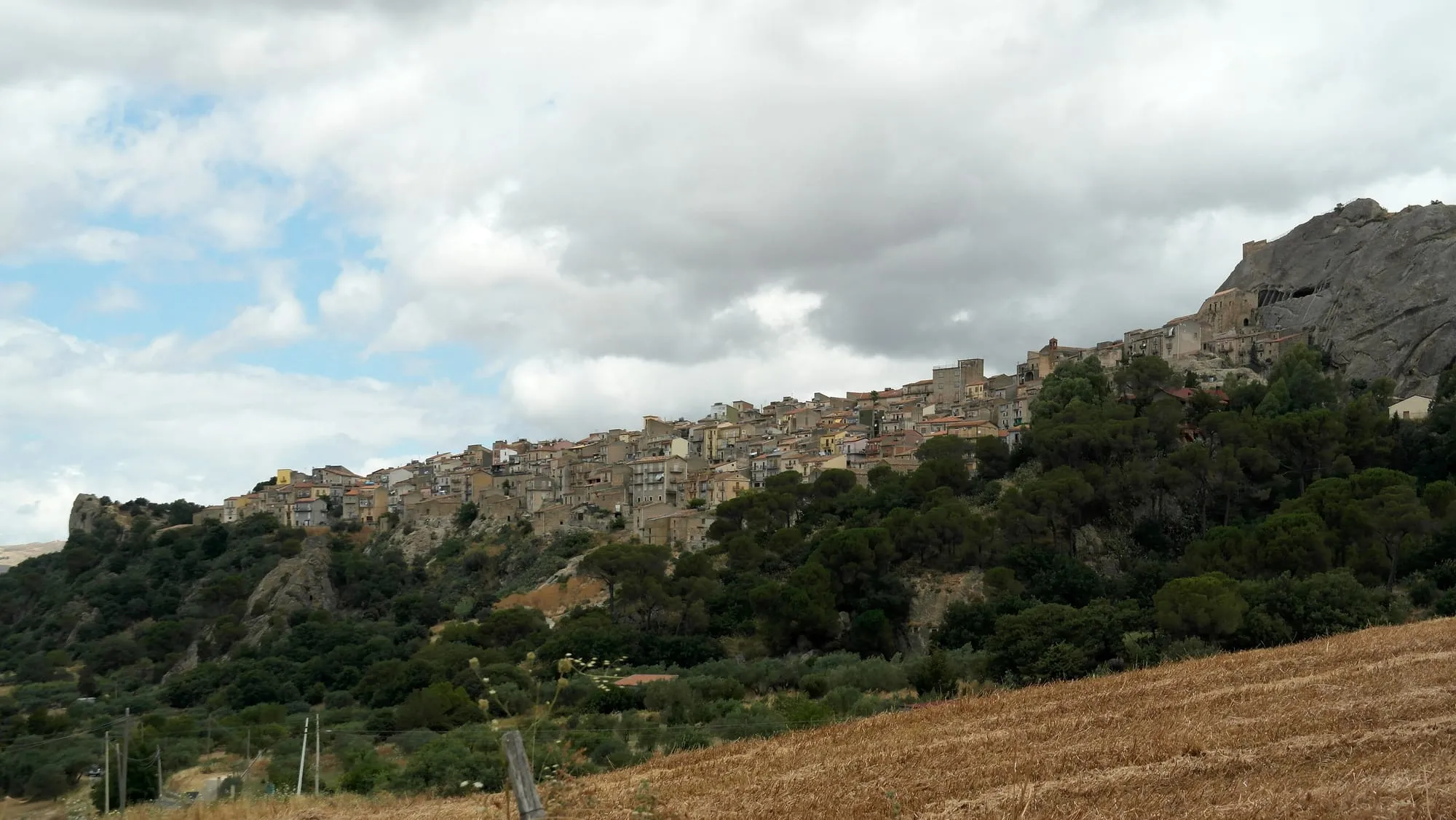 Sperlinga, about ten kilometres from Nicosia. Photo © trolvag, CC BY-SA 3.0.
About ten kilometres along the SS120, Sperlinga is one of “Italy’s most beautiful villages”: just over 600 residents and a castle half built and half carved into a mass of sandstone, with about fifty caves lived in until the mid-20th century at its foot. On the castle sits the motto of the Sicilian Vespers: Quod Siculis placuit, sola Sperlinga negavit — what pleased the Sicilians, only Sperlinga refused.
The other way, toward Troina, Cerami lies inside the Nebrodi Park: a castle on a crag, a 16th-century mother church with a Madonna by Antonello Gagini, and a bridge of Norman tradition known as “di Cicerone”. In 1063, nearby, Roger’s Normans won the battle of Cerami, one of the turning points of the island’s conquest.
How to get there and how long to stay
The easiest way is by car: from the A19 Palermo-Catania motorway you climb toward Nicosia on the inland state roads. Buses exist, but timetables should be checked on the operators’ channels. Routes, buses, nearest railway stations and parking are in the guide on how to get to Nicosia.
How long to stay: a full day covers the historic centre, Cathedral and Castle. With two days you can add the mountains and a nearby village — that’s the format we recommend.
Frequently asked questions
How much time do you need to visit Nicosia?
A day for the historic centre (Cathedral, Santa Maria Maggiore, Castle, Giudecca). Two days if you want to add the Sambuchetti-Campanito reserve or Sperlinga and Cerami.
Why does it share a name with the capital of Cyprus?
It’s a case of coincidence: the two cities have no documented historical link. When searching online, always add “Sicily” or “Enna” to your search.
Can you see the Cathedral’s wooden ceiling?
Not with the naked eye: it’s hidden above the 19th-century vault. Since June 2024 you can explore it through the Diocese’s multimedia platform; details are on the Cathedral page.
Is Nicosia in the Nebrodi Park?
No: its mountains are part of the western Nebrodi, but the municipal territory is outside the park boundary. The Sambuchetti-Campanito nature reserve, between Nicosia and Cerami, is freely accessible all the same.
What do you eat in Nicosia?
Cheeses (including the Albereto dairy’s buffalo mozzarella), extra-virgin olive oil, home-made pasta and traditional sweets, plus the craft beers of the 24 Baroni brewery. The food experiences let you taste the supply chain straight from the producers.
Sources
Comune di Nicosia (“Nicosia in breve”), Ecomuseo Petra d’Asgotto, FAI — I Luoghi del Cuore (Castle and cave dwellings), Chiese di Sicilia — CESi (multimedia platform of the painted ceiling, 2024), Sicilian Region — ORBS portal (Sambuchetti-Campanito reserve), Treccani (Gallo-Italic communities), I Borghi più belli d’Italia (Sperlinga), Parco dei Nebrodi (towns in the park), Italia Judaica — University of Tel Aviv (Giudecca), Wikipedia for dates and works.