Nicosia makes a good base for discovering inland Sicily, the part coastal crowds almost always skip. Within about fifteen kilometres, along the SS120, you reach two villages worth a trip on their own: Sperlinga, with its castle carved into the rock, and Cerami, perched on a crag above its river. They also have a practical advantage for anyone searching online: they’re named that and nothing else, without the Cyprus mix-up that follows the name of Nicosia.
Here’s what to see, and how to tie the villages into a single trip.
Sperlinga: the castle in the rock
About ten kilometres to the north, along the SS120, Sperlinga is one of “Italy’s most beautiful villages”: just over six hundred residents and a castle half built and half carved into a mass of sandstone, with halls, stairs and tunnels cut straight into the stone — a rare thing among Sicilian castles. At its foot opens a whole quarter of caves, about fifty, lived in until the mid-20th century.
On the castle entrance sits the motto of the Vespers: Quod Siculis placuit, sola Sperlinga negavit — “what pleased the Sicilians, only Sperlinga refused”. It recalls that, in the 1282 revolt, Sperlinga alone did not follow the island, sheltering an Angevin garrison while all Sicily rose up. The castle can be visited and holds a small Palatine Chapel.
Cerami: the village on the crag and the Norman battle
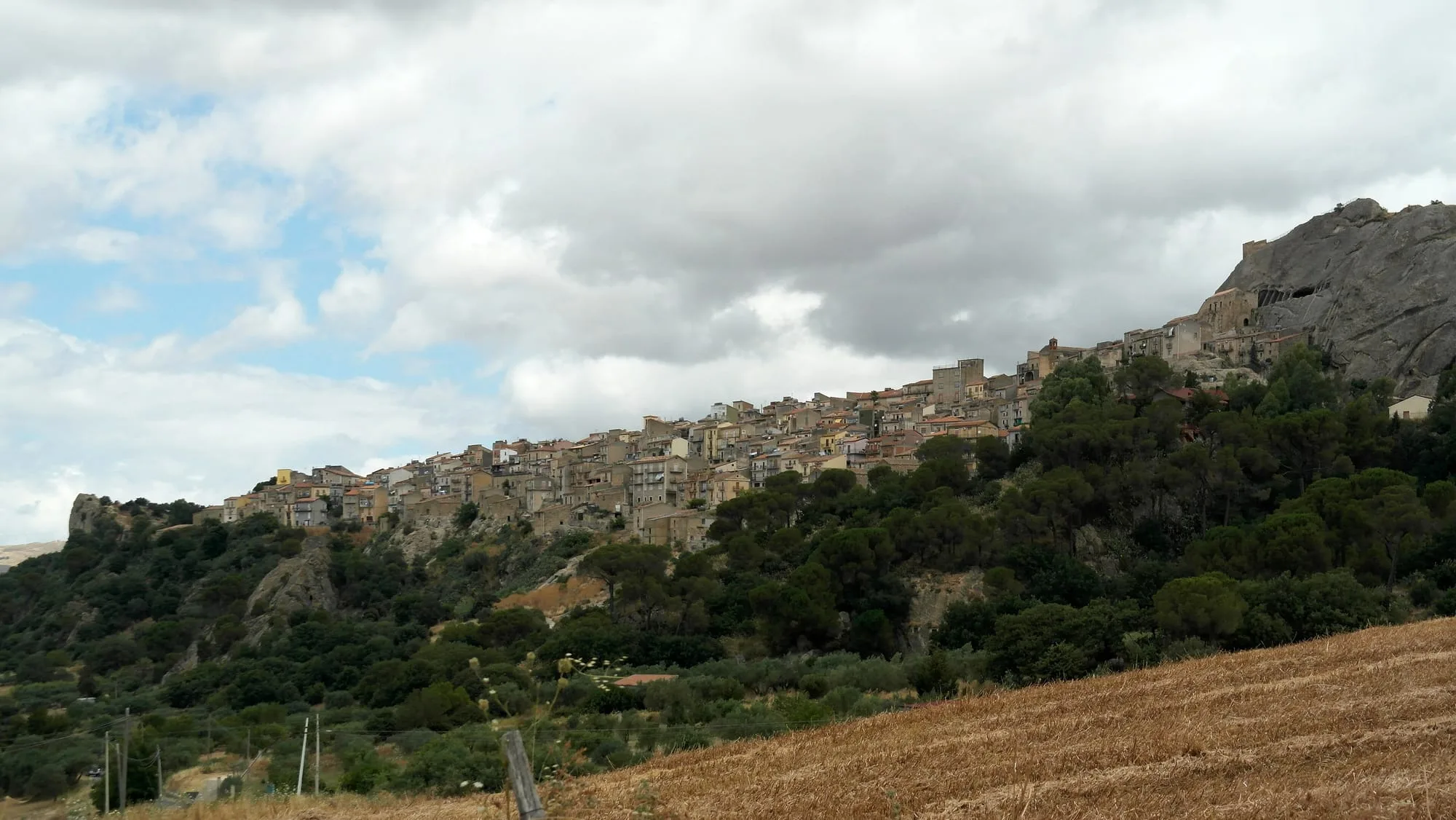
A quarter of an hour to the east, still on the SS120, Cerami lies inside the Nebrodi Park: a village built on a limestone crag that dominates the valley of the river of the same name. The 16th-century mother church holds a Madonna attributed to Antonello Gagini, and over the river survives a bridge of Norman tradition known as “di Cicerone”.
Cerami’s name is tied to an episode of the island’s conquest: in 1063, nearby, Roger’s Normans won the battle of Cerami, one of the turning points that opened Sicily to the conquerors from the North. Today the village is the third and final stage of the Cammino dei 24 Baroni, and at the foot of the centre runs a trekking path along the river.
Beyond the Cammino: the inland Sicily of villages
Sperlinga and Cerami are the two nearest partner villages, but the area fans out toward the Nebrodi and the Madonie. To the west, toward the Madonie, is Gangi, in the province of Palermo, which in 2014 won the title of “Borgo dei Borghi” in the Rai 3 contest: a nativity scene of stone clinging to the hill. Around it, between the Nebrodi and inland Sicily, line up other historic towns such as Troina and Mistretta, reached along the same ridge roads.
By car, the SS120 and the SS120 are the backbone: easy, but full of bends and views.
Getting around the villages
The villages have no convenient public links between them: a car is effectively needed to move from one to the next. From Nicosia, Sperlinga is about a quarter of an hour away and Cerami a little farther. To plan your arrival from outside there’s the guide on how to get to Nicosia; for the town that serves as a base, the guide to things to do in Nicosia.
Frequently asked questions
Which villages can you visit near Nicosia?
The two nearest are Sperlinga (about 10 km, castle carved into the rock) and Cerami (about 15 km, village on a crag in the Nebrodi Park). Farther west, toward the Madonie, is Gangi.
How far is Sperlinga from Nicosia?
About ten kilometres along the SS120 north, a quarter of an hour by car. It’s the second stage of the Cammino dei 24 Baroni.
Can you link the villages on foot?
Yes: the Cammino dei 24 Baroni connects Nicosia, Sperlinga and Cerami in three stages. By car you use the SS120 and the SS120.
What makes Sperlinga’s castle special?
It’s partly carved into the rock, with rooms cut straight into the sandstone, and it’s tied to the motto of the Sicilian Vespers: Sperlinga alone did not join the 1282 revolt.
Sources
Vivi Nicosia territory records (Sperlinga, Cerami, Nebrodi Park), I Borghi più belli d’Italia (Sperlinga), Rai 3 — “Borgo dei Borghi” 2014 (Gangi), local historical documentation on the battle of Cerami (1063) and Sperlinga castle.