The Cathedral Basilica of San Nicolò di Bari is the landmark monument of Nicosia, in the province of Enna, Sicily. Anyone entering from Piazza Garibaldi sees three naves, 19th-century decoration, a large crucifix on the altar. What they don’t see is the reason this church has been a national monument since 1940: above the vault, closed in the roof space for more than two centuries, survives a painted wooden ceiling from the 1400s that Federico Zeri called “an extraordinary, unique monument”.
This guide lines up the history, the things to look for, and the way — finally possible today — to see the ceiling. For opening times and quick information there’s also the Cathedral summary page.
Seven centuries in six dates
The monument’s history can be told in stages, all documented.
- 1305 — the building appears in the records as “cappella sancti Nicolai de plano”, a small chapel on the plain below the hills.
- Early 1300s — after the Peace of Caltabellotta, under the reign of Frederick II of Aragon, a grand rebuilding begins; an inscription on the Porta del Monte records the church in use in 1340.
- 1388 — San Nicolò is recognised as a parish by the Archbishop of Messina; in 1521 Leo X raises it to a collegiate church.
- 1817 — with the bull “Superaddita diei” Pius VII establishes the diocese of Nicosia: the church becomes a cathedral. The solemn consecration comes in 1856.
- 1940 — a Royal Decree declares it a national monument.
- 1967 — Paul VI grants it the title of minor basilica.
One detail that explains much about the town: for centuries the collegiate church of San Nicolò and the Basilica of Santa Maria Maggiore were the poles of two rival quarters, Nicoleti and Mariani. The rivalry is over; the two bell towers remain.
The exterior: the Porta del Paradiso and the bell tower
The 14th-century main portal has always been called the Porta del Paradiso: Gothic, framed by carved bands where acanthus leaves dominate. It was recently restored, along with its access staircase, with works completed in March 2024.
Beside it rises the bell tower, a three-tier Gothic tower about 40 metres tall, with pointed arches and mullioned windows: inscriptions and studies date its second tier between 1393 and 1455. The spire has a troubled history — split by lightning in 1962, left for decades under temporary coverings and scaffolding, then at the centre of a contested worksite halted in 2016 — and was eventually rebuilt; in the summer of 2025 the tower was lit from within for the first time, in a test under review by the Enna Superintendence.
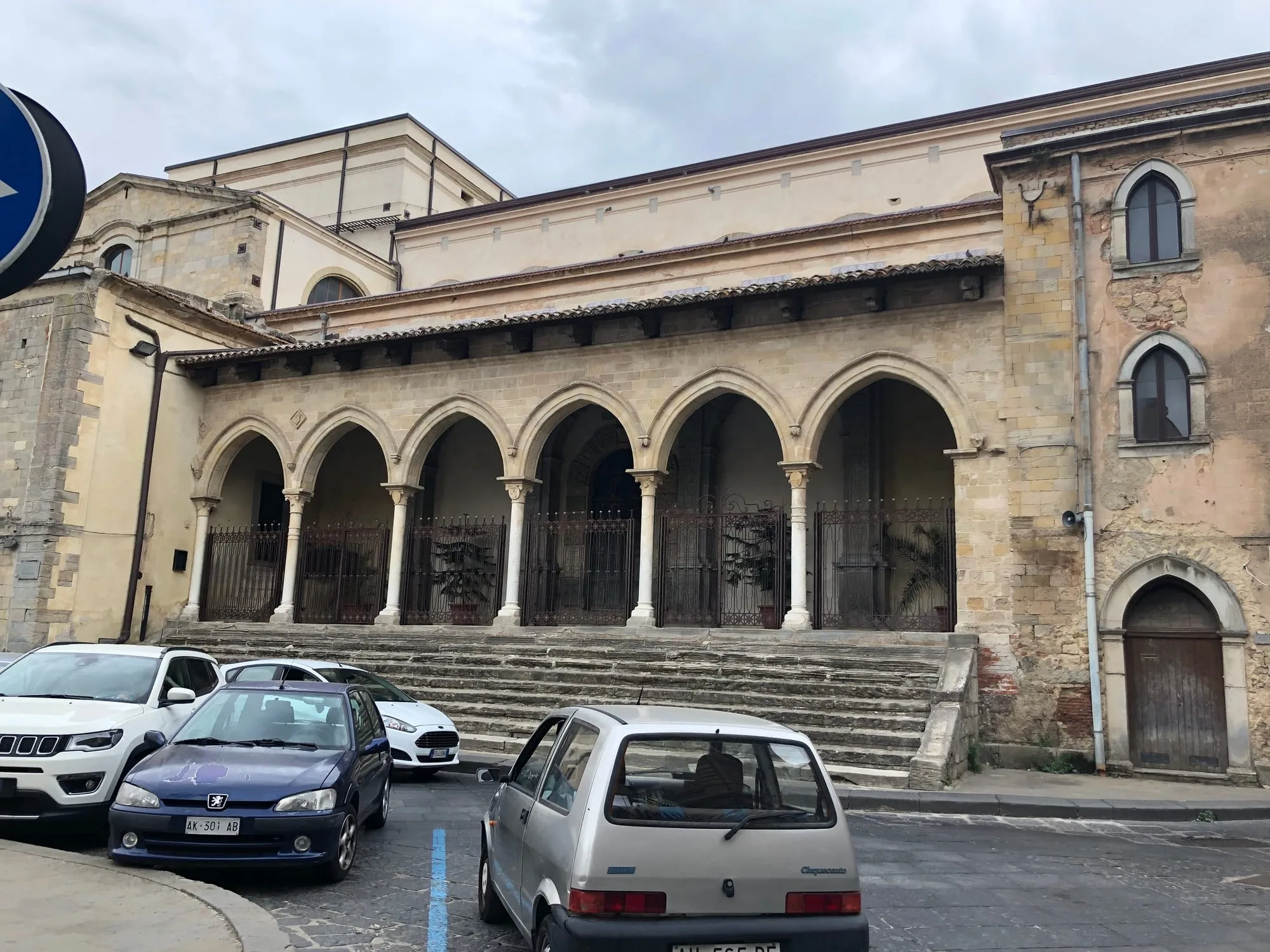
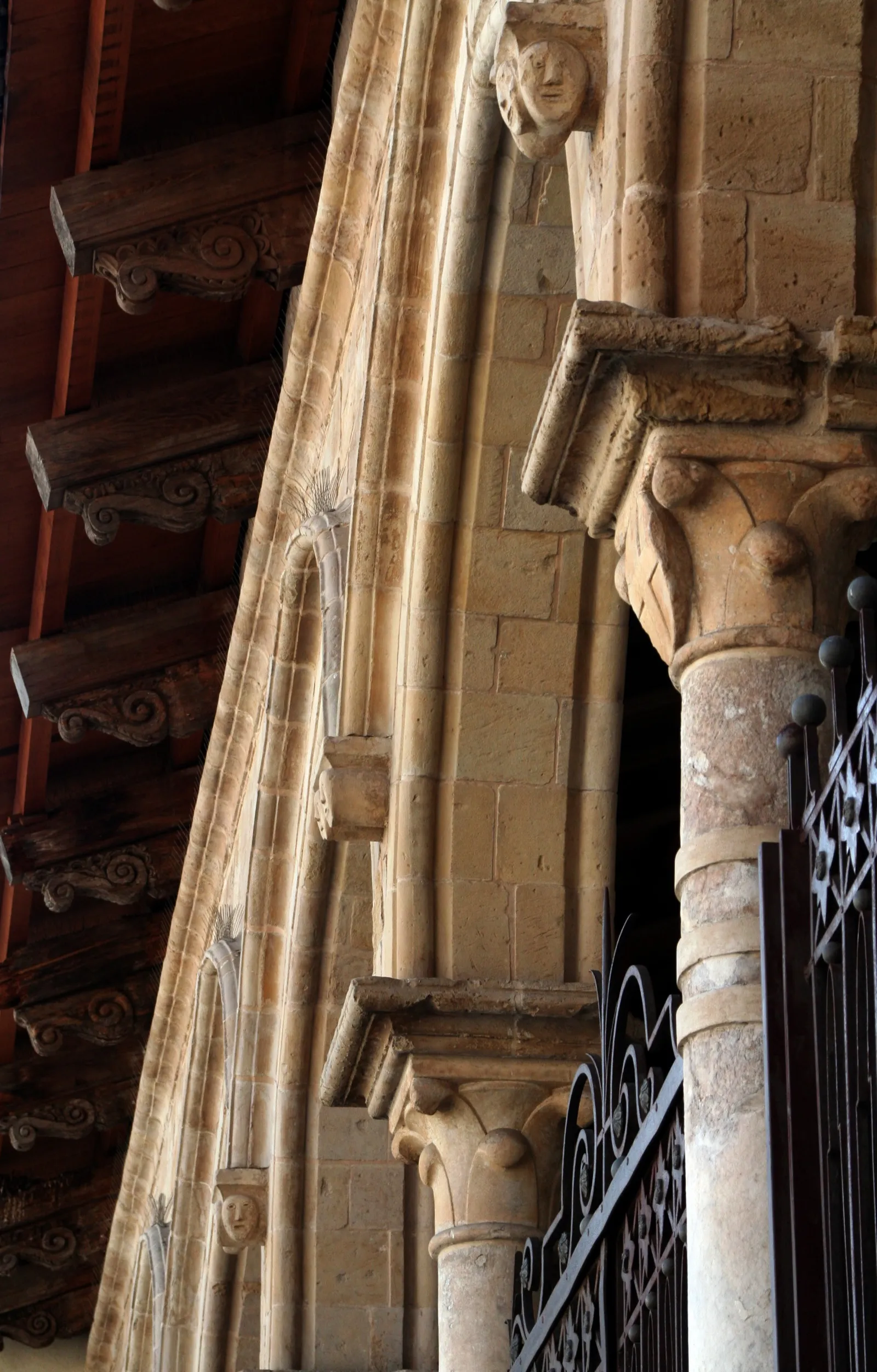
On the north side opens the 15th-century loggia (1489-1490), the work of sculptors Gabriele di Battista and Andrea Mancino.
The interior: Gagini, Li Volsi and the “Father of Providence”
The interior has three naves divided by twelve columns. The works to seek out:
- the baptismal font in marble by Antonello Gagini (1497-1499);
- the octagonal marble pulpit from the mid-1500s, of the Gagini school;
- the wooden choir in walnut, thirty stalls carved by the Li Volsi, the family of sculptors who signed half of Baroque Nicosia;
- a Martyrdom of Saint Bartholomew attributed to Jusepe de Ribera, lo Spagnoletto;
- the Crucifix of the “Father of Providence”, long attributed to Fra Umile da Petralia and now traced to the Palermo crucifix-maker Gaspare De Miceli, who was commissioned to make it in 1630. The epithet comes from tradition: in 1635, carried in procession against drought, it is said to have brought back the rain. It still comes out every Good Friday, during the Casazza.
The ceiling you can’t see
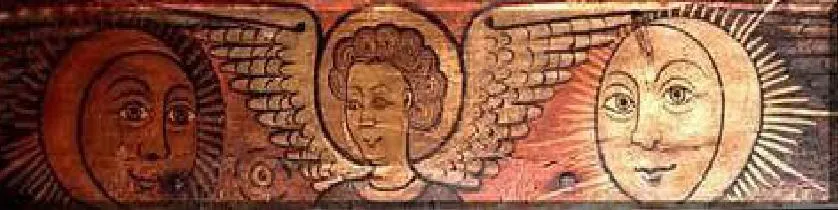
Now the hidden part. In 1810 the interior was redone to the taste of the age: a plaster barrel vault, frescoed by the brothers Antonio and Vincenzo Manno of Palermo, covered the central nave. Above that vault, though, the old medieval roof was not dismantled. It stayed there: a painted truss ceiling that the Sicilian Bishops’ Conference presents as the only example of its kind in Italy.
The painted repertoire is surprising for a cathedral: alongside sacred scenes — from the Expulsion from Paradise to the Coronation of the Virgin, in what Mons. Crispino Valenziano read as a history of Salvation — most of the images are secular. Ladies and children, hunting and everyday scenes, wild animals, grotesques, a Gothic alphabet of twenty-four letters, the coats of arms of the Ventimiglia, De Marchisio and Sabia families. Between the fifth and sixth bays, four scrolls carry Latin mottoes drawn from Aesop’s fables, as art historian Licia Buttà reconstructed in “Storia dell’Arte” (2011).
On the dating, scholars stay cautious: the heraldic and iconographic clues — the Ventimiglia arms, the Aragonese emblems, a monogram of Christ that points to after 1435 — place the cycle in the first half of the 15th century, without a firm date. It’s the same era as the great Sicilian wooden ceilings, like the one in the Sala Magna of the Steri in Palermo (1377-1380), with one difference: the Steri’s is the ceiling of a palace, this is the roof of a cathedral.
The rediscovery is a 20th-century story: the first studies arrive at the start of the century, with a publication in 1917, and since then the ceiling has returned periodically to scholarly attention, up to the international study day held in Nicosia in September 2019 with specialists from France, Spain and Italy.
How to see it today
For almost a century the ceiling was material for scholars and restorers. Since 1 June 2024 there’s a route open to everyone: the multimedia platform made by the diocesan Office for Cultural Heritage, the result of a 2020 agreement between the Comune, the Church and the Kore University of Enna. It lets you explore the bays up close, panel by panel, with a level of detail the naked eye — even from the roof space — wouldn’t have.
For access arrangements, guided visits and special openings, the reference is the Diocese of Nicosia (Largo Duomo 10, tel. 0935 646040, bcec@diocesinicosia.it). A few steps away, on via San Biagio, the Diocesan Museum completes the route with the Cathedral treasury and the sacred art of the area.
Practical information
- Where: the main entrance is on Piazza Garibaldi, in the heart of the historic centre; access is via the staircase restored in 2024.
- When: the Cathedral is open for worship, roughly in the morning and late afternoon; times of Masses and visits should be confirmed with the Diocese (0935 646040).
- With whom: the historic-centre walking tour starts right here and sets the Cathedral in the context of the baronial palaces.
- When it counts double: 6 December for the feast of San Nicolò, patron of the town, during Holy Week for the Casazza.
For the full picture of the town there’s our guide to things to do in Nicosia.
Frequently asked questions
Why can’t the wooden ceiling be seen from inside?
Because in 1810 the nave was covered by a plaster barrel vault, frescoed by the Manno brothers. The painted medieval roof stayed intact above the vault, in the roof space.
How can you see the painted ceiling?
Since June 2024, through the multimedia platform of the diocesan Office for Cultural Heritage. For information on access and visits: Diocese of Nicosia, 0935 646040.
How old is the ceiling?
Studies place it between the late 1300s and the first half of the 1400s, with clues pointing above all to the early 15th century. A firm date doesn’t exist, and that’s part of its allure.
How much time do you need for the visit?
Half an hour for the interior, more if you add the multimedia platform and the Diocesan Museum. The Cathedral is the natural first stop of a day in Nicosia.
Sources
Diocese of Nicosia (diocesinicosia.it), Chiese di Sicilia — CESi (multimedia platform, 2024), BeWeB — Beni ecclesiastici in web (cathedral record), Ecomuseo Petra d’Asgotto (Cathedral and wooden-ceiling records), Licia Buttà, “Storia dell’Arte” no. 130 (2011), Italia Nostra Sicilia (the spire affair, 2016), TeleNicosia (restorations and platform, 2024-2025), Wikipedia for works and dates.