2026 edition over
The next edition has no date yet.
When the organisers set one, this page updates.
The farmers’ saint
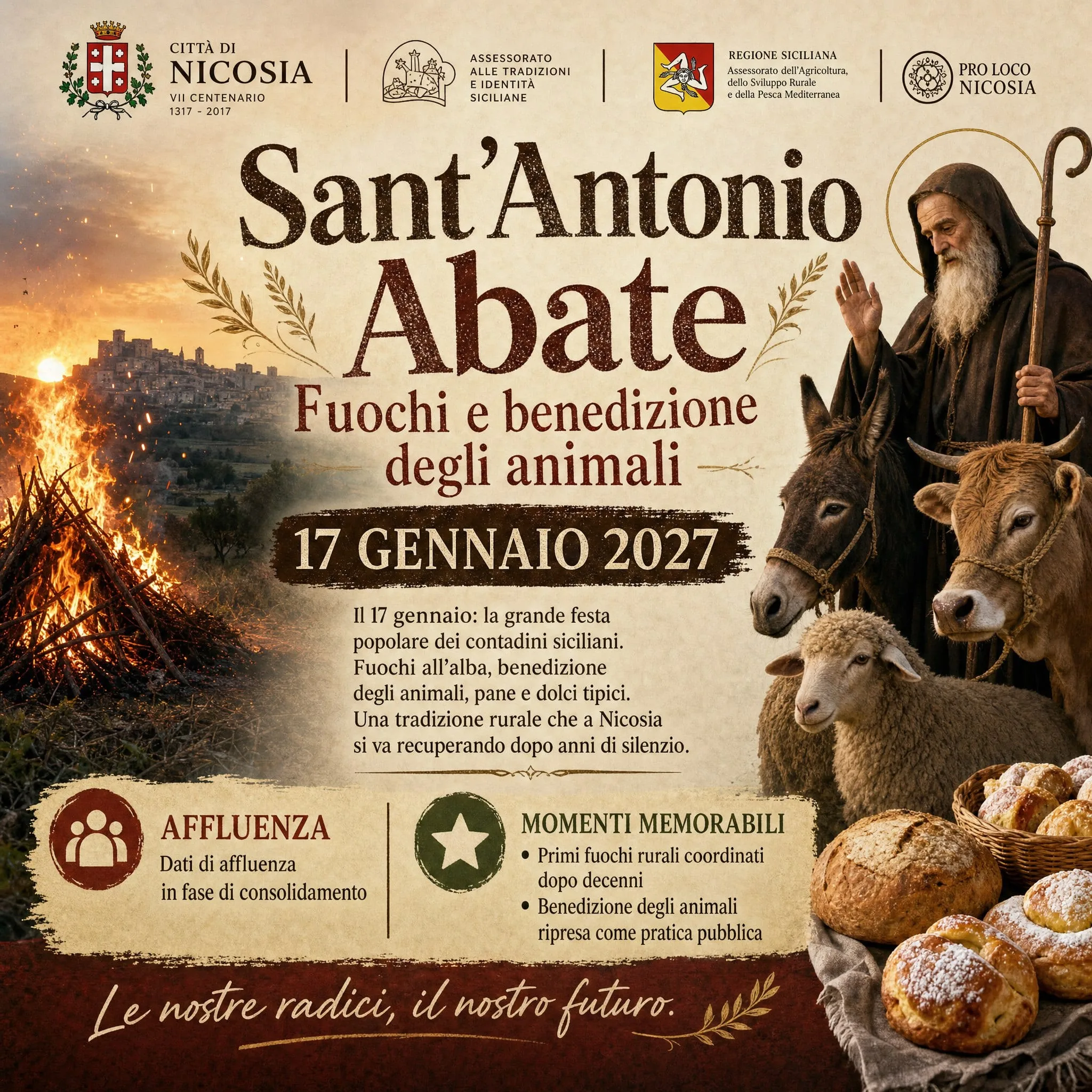
Saint Anthony the Abbot — Egyptian hermit of the 4th century, model of monastic life, patron of many popular categories — has for centuries been the saint of Sicilian farmers. His feast on 17 January is one of the oldest and most deeply rooted in the island’s agrarian culture.
In Nicosia, as throughout inland Sicily, the feast of Saint Anthony the Abbot revolved around three elements:
- The solemn Mass in the church dedicated to the saint;
- The blessing of domestic animals on the parvis;
- The rural bonfires lit at dawn or dusk in the districts.
The blessing of the animals
The visually strongest ritual of the feast is the blessing of domestic animals. Nicosians — especially those who live in rural districts and keep ties to herding or farming — bring to the parvis of the church of Saint Anthony:
- household dogs and cats;
- donkeys, horses and mules from the masserie;
- goats and sheep from the pastoral families;
- chickens (more rarely, but still present).
The parish priest blesses the animals one by one, while owners recite a short prayer. It is an ancient rite — at least medieval — expressing the link between human life and agro-pastoral life.
Saint Anthony’s bonfires
On the evening of 17 January, in the rural districts of Nicosia, Saint Anthony’s bonfires are lit: great communal pyres around which families, neighbours and animals gather. The rite has pre-Christian roots (winter purification fire) and survived in a Christian form thanks to the hermit Saint Anthony who — according to legend — had defeated the devil’s temptations with fire.
In Nicosia the bonfires are traditionally lit in:
- Contrada Castagna (near Masseria Rossignolo);
- Contrada Albereto (near the dairy);
- Contrada Acqua Santa;
- Villadoro hamlet (where the tradition remains particularly strong).
Saint Anthony’s loaves
A typical gastronomic element of the feast is the Saint Anthony loaves: small round breads, blessed, with a cross etched on top. They are made in the historic-centre pastry shops and distributed free of charge to those attending the Mass and the blessing.
Tradition has it that the loaves are kept at home throughout the year, as a charm against fire (domestic fires). These are practices of popular religiosity passed down from generation to generation.
Why we talk about it
For decades the feast of Saint Anthony the Abbot in Nicosia had become almost invisible: a sparsely attended parish Mass, no animal blessing on the parvis, the rural bonfires put out. Since 2025 the Municipality and the rural parishes have begun reviving the practice in a coordinated and safe form, aiming not to let die a tradition that links the town to its rural past.
Visiting
- Solemn Mass: 6 pm in the church of Saint Anthony.
- Animal blessing: on the parvis right after Mass (around 7 pm).
- Rural bonfires: in the indicated districts, from 5:30 pm to dusk.
It is a rural, family feast. Visitors from outside are welcome in a spirit of participation rather than tourist observation.