A masterpiece comes home
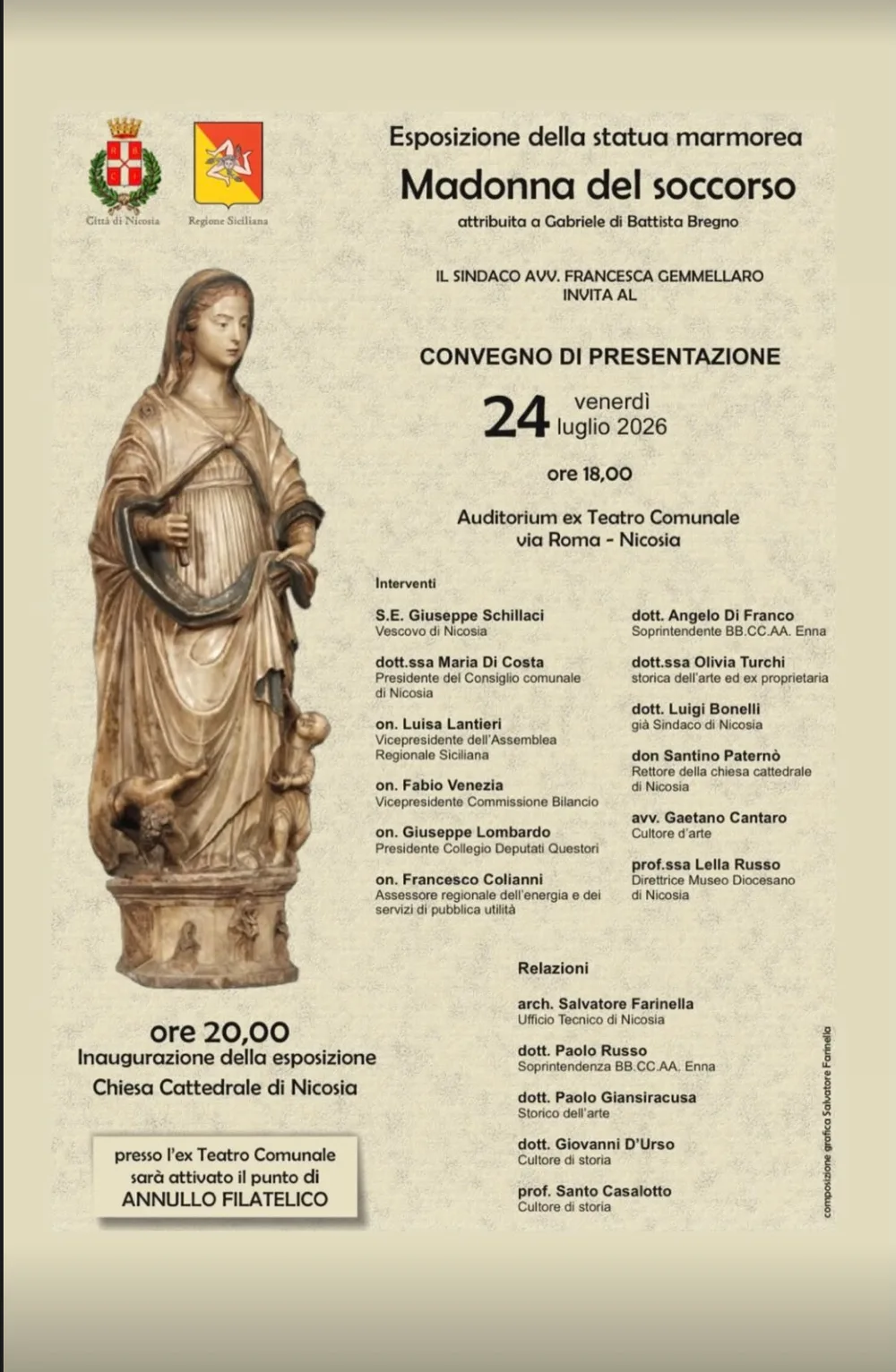
The Madonna del Soccorso is a Renaissance marble statue carved for the devotion of the nobleman Vincenzo La Via, for the church attached to Nicosia’s Benedictine convent.
The attribution to the Lombard sculptor Gabriele di Battista (Bregno) is the received one, but it is not settled: at the 24 July conference the art historian Paolo Giansiracusa questioned it, calling for further study and for a restoration that would bring back the original colours. The dating shifts with the source too: the report of the day says 15th century, the agreement says late 15th to early 16th, and the auction appraisal calls it 16th-century.
Removed from the town in 1866 under the laws confiscating ecclesiastical property, the work resurfaced more than a century later in the Turchi collection in Florence. The auction was stopped on 26 October 2023, hours before the sale, by the protection notice signed by the Superintendent for Cultural Heritage of Enna, architect Angelo Di Franco. The purchase was then funded by the Sicilian Region through an amendment, and the statue physically returned to Nicosia on 20 November 2024, kept until the exhibition in the municipal Technical Office stores in via Bernardo Di Falco.
24 July 2026 is the date of the public restitution — not of the return, which had happened twenty months earlier.
How Friday 24 July went
The day opened at 6pm with the conference in the auditorium of the former Teatro Comunale. Mayor Anna Maria Gemmellaro opened it, retracing the whole path of the statue’s return; institutional greetings came from the President of the town council Maria Di Costa and former president Sigismundo Li Volsi.
On the political side, MP Fabio Venezia set out the route that led to the regional funding for the purchase through a dedicated amendment; the regional minister for Energy Francesco Colianni confirmed the regional government’s willingness to back further conservation work; MP Luisa Lantieri, co-signer of the amendment, was away on official business and was represented by town councillor Francesco Spedale.
The Bishop of Nicosia, Mgr Giuseppe Schillaci, spoke of the spiritual meaning of the return. Superintendent Angelo Di Franco recalled his own decisive move in stopping the auction, and lawyer Gaetano Cantaro the technical and legal procedures that made the return possible. Olivia Turchi, art historian, also spoke about the work’s recent history. The first half closed with Father Santino Paternò, Lella Russo, director of the Diocesan Museum of Sacred Art, and Lia Murè, president of Nicosia’s Pro Loco.
The news of the conference, though, was something else: Paolo Giansiracusa’s critical reading of the attribution to Bregno, which reopened the question of the sculptor’s name.
A festive procession then set off from via Roma with the flag-throwers and musicians of Civitas Nicosiae, led by maestro Giuseppe Tamburello, along via Fratelli Testa to the Bell Tower. At 8pm the Cathedral gate was opened: in the prepared room, the statue was unveiled.
The philatelic postmark
In the courtyard of the former Teatro Comunale, Poste Italiane set up a special philatelic postmark, with a postcard showing the statue and a prayer in Gallo-Italic, Nicosia’s distinctive dialect, recited during the event by Patrizia Castrogiovanni.
Where it is now, and on what terms
The statue is in the Cathedral, at the base of the bell tower. The agreement approved on 5 February 2026 commits the Cathedral to keeping the work open to the public outside the hours of liturgical services.
It is worth stating how that agreement is written, because it differs from how the story is told: it is neither a donation nor a permanent exhibition, but a two-year temporary deposit, renewed automatically year by year unless either party withdraws. The Municipality of Nicosia remains the owner. The word “permanent” appears once only, in the announcement published before the ceremony, and not in the report of the following day.
Sources
The account of the day is from TeleNicosia, 25 July 2026; the terms of the agreement and the date of the physical return come from TeleNicosia, 9 February 2026.
One spelling is not confirmed, and it is flagged rather than hidden: “Sigismundo Li Volsi” appears once, in a single source, where the expected Italian form would be “Sigismondo”. It should be checked before it is trusted.